Accurately predicting the value of retired LEGO sets and minifigures requires more than simple historical trends—it demands advanced analytics, machine learning, and proprietary forecasting models. At BrickEconomy, we leverage AI-driven algorithms to analyze sales data, market trends, and collector demand to estimate both current and future values with precision. This article explores how we calculate market prices, forecast appreciation trends, and adjust for factors like short-term post-retirement price spikes. By combining data science with LEGO market expertise, we provide collectors and investors with the most reliable valuation models available.
Overview
Accurately estimating the current market value of LEGO sets and minifigures requires advanced predictive modeling that accounts for global price variations, regional demand, and supply chain fluctuations. At BrickEconomy, we employ supervised learning algorithms such as Gradient Boosted Decision Trees (GBDT) and Neural Networks to analyze extensive datasets, including historical sales, retail stock levels, and consumer demand signals. These models leverage feature engineering techniques to incorporate region-specific pricing trends, currency fluctuations, and market segmentation, ensuring that valuation estimates are localized rather than based on a single, global average.
One of the biggest challenges in LEGO pricing prediction is that values typically do not appreciate significantly until a set is fully retired. However, this trend differs for exclusive or limited-production sets and minifigures, such as those from Comic-Con, Toy Fairs, Inside Tours, employee gifts, grand openings, and other special releases, which often command high value from the outset. This is because active production maintains a steady supply, keeping prices near MSRP. Our models integrate inventory tracking from major retailers such as LEGO.com, Amazon, Walmart, and dozens of regional retailers (LEGO Certified Stores, TRU, Bricks & Minifigs, Zavvi, JB Spielwaren, Target etc.) monitoring stock depletion rates to detect when a set is approaching retirement. Once a set becomes unavailable at primary retailers, our models adjust valuation forecasts dynamically, factoring in reseller activity, secondary market demand, and historical post-retirement appreciation patterns.
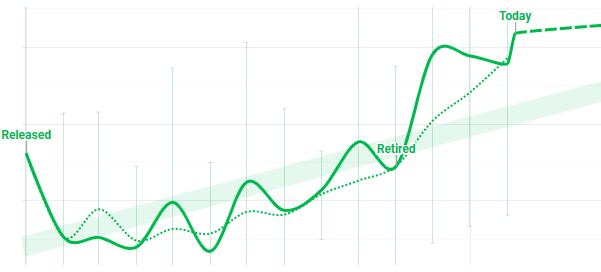
A key phenomenon in LEGO investing is the “retirement pop”, where a set’s value spikes immediately after it leaves production. This occurs because supply is suddenly capped, and third-party resellers take over market distribution. Using time-series forecasting models like ARIMA (AutoRegressive Integrated Moving Average) and LSTMs (Long Short-Term Memory networks), we quantify this effect by analyzing past retirement cycles. Data shows that most LEGO sets experience an immediate price increase upon retirement, followed by an accelerated appreciation phase over the next 6-24 months before stabilizing into more predictable long-term growth. By incorporating these insights, BrickEconomy’s AI-powered valuation models provide LEGO collectors and investors with the most accurate, data-driven price estimates and future value forecasts available.
The AI Models Powering BrickEconomy’s LEGO Valuations
BrickEconomy’s valuation models leverage multi-modal machine learning architectures trained on real-time transactional data aggregated from platforms such as eBay, Amazon, and BrickLink. Our system employs a heterogeneous ensemble approach, combining Gradient Boosting Machines (GBMs) like XGBoost with Recurrent Neural Networks (RNNs)—specifically LSTM (Long Short-Term Memory) networks—to model temporal dependencies in LEGO set and minifigure pricing. These models process structured numerical inputs (e.g., price fluctuations, sales velocity, historical CAGR) alongside unstructured data sources, such as listing descriptions and seller reputation, extracted via Natural Language Processing (NLP) techniques.
Beyond raw pricing data, our models incorporate market liquidity constraints by quantifying the time-on-market (TOM) for each listing. We employ a survival analysis framework using Cox Proportional Hazard Models, allowing us to estimate the probability of a set remaining unsold at a given price over time. This is complemented by Bayesian Structural Time Series (BSTS) models, which account for macroeconomic indicators such as regional inflation, currency fluctuations, and discretionary spending trends, ensuring that valuations reflect localized demand. For example, while a set may command a premium in high-GDP per capita regions such as the United States or Germany, supply-side constraints in other markets (e.g., emerging economies with import restrictions) necessitate distinct valuation adjustments. By integrating global arbitrage detection, our AI framework recognizes regional pricing inefficiencies, providing collectors with data-driven insights into where and when to buy or sell LEGO assets for optimal returns.
Modeling Future Growth of LEGO Sets and Minifigures
Forecasting the future growth of LEGO sets and minifigures requires a multi-factor predictive modeling approach that incorporates theme-based appreciation trends, supply constraints, consumer demand cycles, and external market influences. At BrickEconomy, we employ a hybrid machine learning model combining Gradient Boosted Regression Trees (GBRT) and Recurrent Neural Networks (RNNs), specifically LSTM (Long Short-Term Memory) models, to capture the non-linear growth trajectories of LEGO assets over time.
Theme-Based Growth Factors
One of the most influential predictors in our model is the theme and subtheme classification of a set. Historical data shows that licensed themes (e.g., Star Wars, Harry Potter, Lord of the Rings) tend to exhibit higher and more sustained post-retirement appreciation than non-licensed themes like City or Friends. Our models incorporate Bayesian Hierarchical Modeling to estimate the expected growth trajectory of a set based on its theme, factoring in:
- Past performance of the theme (e.g., Star Wars sets historically appreciate at higher rates).
- Total number of sets released within the theme (fewer releases generally correlate with higher long-term value).
- Subtheme duration and lifecycle (e.g., shorter-lived subthemes tend to have stronger long-term appreciation).
- Average lifespan of sets within the theme (e.g., UCS Star Wars sets typically retire after multiple years, whereas City sets rotate faster).
These factors enable our AI models to generate theme-weighted growth expectations, ensuring that sets are not evaluated in isolation but rather in the context of their broader LEGO ecosystem.
Modeling the "Retirement Pop" and Growth Phases
LEGO set values do not follow a linear appreciation model. Instead, our models break post-retirement value trajectories into three primary phases:
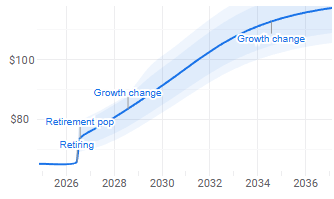 Retirement Pop: Upon retirement, ~95% of retailers sell out, shifting supply control to third-party resellers. This supply shock triggers an immediate price surge of 20-30% on average (depending on many factors), which we quantify using Bayesian Change Point Detection (BCPD) to identify discontinuities in pricing trends.
- Rapid Appreciation Phase (6-18 months post-retirement): After the initial price spike, most sets see a compounded appreciation rate of 10-20% annually as supply dwindles and secondary market demand solidifies. Our Holt-Winters Exponential Smoothing Model accounts for this acceleration, incorporating market liquidity indicators such as the frequency of listings vs. actual sales transactions.
- Stabilization & Maturity Phase (2+ years post-retirement): Growth begins to normalize, and appreciation rates stabilize into a more predictable, long-term trajectory. Using Markov Chain Monte Carlo (MCMC) simulations, we estimate the probability distributions of a set’s long-term value retention based on historical comparables.
Impact of Re-Releases on Long-Term Value
One of the most critical risk factors in LEGO investing is set re-releases or successor models, which can drastically reduce long-term appreciation. Our model incorporates a set replacement risk coefficient, calculated using:
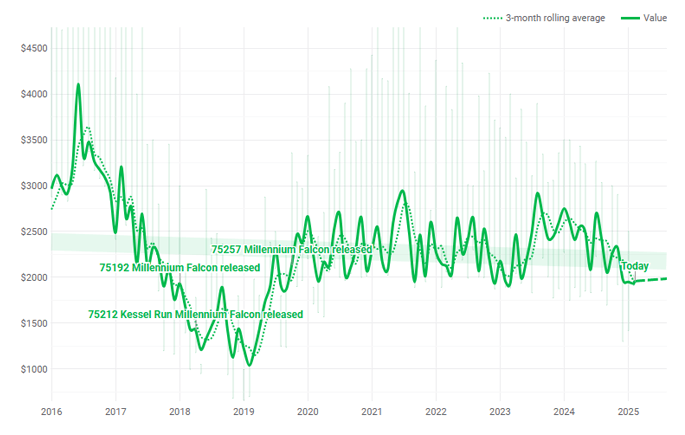
- Historical impact of past re-releases (e.g., The UCS Millennium Falcon 10179 experienced a 30% decline in value after LEGO announced newer Falcon models. As shown in the chart below, the decline began months before the actual release, driven solely by market speculation and rumors.)
- The frequency of re-releases within a theme (e.g., Star Wars ships and Harry Potter sets for example have a high likelihood of being reintroduced).
- Set uniqueness and exclusivity (e.g., sets with unique minifigures or limited production runs tend to be less affected).
By combining these factors into our forecasting engine, BrickEconomy provides data-driven insights into the true investment potential of LEGO sets and minifigures, allowing collectors and investors to make informed decisions backed by advanced AI and economic modeling.
Annual Growth: Beyond Traditional CAGR
At BrickEconomy, annual growth rates are not simply derived from Compound Annual Growth Rate (CAGR) formulas. Unlike conventional financial assets, LEGO sets experience nonlinear appreciation cycles, including retirement-induced price spikes, market fluctuations, and long-term stabilization phases. Using a direct CAGR calculation would misrepresent true long-term investment potential by overemphasizing short-term surges. Instead, we apply adjusted growth modeling to provide a more reliable, investment-grade estimate of how a set appreciates post-retirement.
Why We Adjust for the "Retirement Pop"
The "retirement pop" is a well-documented pricing anomaly in LEGO investing, where most sets see an immediate price surge upon retirement due to supply constraints. While this creates an initial spike in returns, it does not represent sustained long-term growth. Our models quantify and isolate this effect using Bayesian Change Point Detection (BCPD) and adjust annual growth rates accordingly. This ensures that investors do not base expectations on an inflated, short-term price distortion but instead on a smoothed, realistic appreciation trajectory.
How We Calculate and Display Annual Growth
To model realistic LEGO investment returns, we employ a multi-phase depreciation-adjusted growth rate model, which accounts for:
- Short-Term Adjustments – Filtering out retirement pop distortions using time-series regression models.
- Market Liquidity Factors – Incorporating listings-to-sales ratios to ensure price movements reflect true market transactions rather than speculative listings.
- Theme-Based Growth Factors – Applying historical theme-based multipliers to adjust expected appreciation curves (e.g., Star Wars vs. City).
- Long-Term Stabilization – Using Holt-Winters Exponential Smoothing to model post-retirement growth slowdowns.
Thus, our displayed annual growth rates reflect a more investment-oriented metric, better aligned with real-world asset performance rather than an overly simplistic CAGR figure. By removing short-term anomalies and speculative market distortions, BrickEconomy provides a more accurate representation of long-term LEGO investment performance, allowing collectors and investors to make data-driven decisions based on realistic appreciation patterns rather than volatile spikes.
Conclusion: Data-Driven LEGO Investing with BrickEconomy
LEGO investing is far more complex than a simple buy-and-hold strategy. Market dynamics, theme-based performance, retirement cycles, and external economic factors all play a role in determining a set’s value over time. At BrickEconomy, we leverage advanced machine learning models, economic forecasting techniques, and historical data analysis to provide collectors and investors with the most accurate, data-driven valuations and growth predictions available.
By refining how we calculate current values, forecasting long-term appreciation, and adjusting for market distortions like the “retirement pop,” BrickEconomy ensures that LEGO enthusiasts have a clear, realistic understanding of set valuations and investment potential. Whether you’re a seasoned investor or just starting out, our platform equips you with the insights needed to make informed, strategic decisions in the ever-evolving LEGO marketplace.
For more insights, explore our valuation tools and stay up to date with the latest market trends on BrickEconomy.
Disclaimer
The pricing data, growth projections, and market analyses provided by BrickEconomy are based on proprietary algorithms, historical trends, and publicly available sales data. While we strive for accuracy, all valuations are estimates and subject to market fluctuations, data inaccuracies, and external factors beyond our control. BrickEconomy does not provide financial advice, and we are not responsible for investment decisions made based on the information presented on our platform. Prices and forecasts should be used for informational purposes only, and users should conduct their own research before making any financial commitments.
Please refer to our Terms of Service for our full investment information disclaimer.